Unknown's avatar

About Susan Labadi

Susan Labadi trains Brain Health, Mindfulness Stress Reduction, and Promotes the Halal Lifestyle

Hajj: The Parallel Universe

26362354_a3e90a7305

Flickr: Muhammad Ghouri

Allow me to sweep you toward a parallel universe, one that has been chronicled to change lives, the pilgrimage to the House of God, the Hajj.

Destiny opened the door to me in April 1989, when I made Ummrah, the lesser pilgrimage made in the off-season, with my husband and 11 other members of his family. By that time, we had been married seven years and had tried several interventions to procure a sustainable pregnancy.

It was said that water from the Meccan holy spring of Zamzam could cure. We all prayed, dutifully performed the sacred rites, the same as in Hajj, and I discovered myself expecting what was to be the first of our four offspring by the time we arrived after our Ummrah to Jerusalem. It was an experience that certainly changed my life, and I still recall the unique and other-worldly perceptions from it.

That is why I gladly accepted the offer of Dr. Badar Zaheer to edit and assist with editing and publishing his work, Hajj: Medical and Practical Solutions (ISBN: 978-1-4675-8505-7). At this time, it is in formatting for publication and Dr. Zaheer will be sharing information from it relevant to pilgrims who have medical conditions such as diabetes, heart disease, hypertension, and some of the general cautions about avoiding dehydration, crowd control, fitness and conditioning before the journey, in-flight exercise, and emergency phone numbers while on Hajj. I will also field questions and inquiries on behalf of ladies who may prefer to talk to another woman about our special issues and medical needs.

The previous blog, “So You Think You Can’t Write” was intended to invite fellow teachers and writers to realize that everyone can document, employ the process of writing, distill through multiple passes of the editing process, and procure something rich. I was not disappointed in the result. There was the prospect that I might teach middle school writing this year, in addition to my other projects, but I was delivered something better suited to my interests with this Hajj project. I believe it will bloom into more editing projects and publishing of my own work and others’.

As preparation for this assignment, my local library presented The Art of Hajj by Venetia Porter (ISBN: 978-1-56656-884-5). It is part of the Bridging Cultures Bookshelf: Muslim Journeys that I have cited before. The book meshes art, including print, textiles, photography, and various Islamic antiquities, with rich prose, quotations, and translations of script from those artifacts. It is a work of love and beauty, and it took me back…

…to Taif, where the Prophet Mohammad was once stoned and chased out of town by its people. Except that later, they greeted him back warmly when many of its residents accepted Islam. (Read the whole story here http://www.saudilife.net/saudi-arabia/84-personalities/252-taifs-most-epic-story) We’d driven all night through the desert in a GMC with seven children and six adults. I recall that we had to stop a few times for bathroom breaks and to pray at a mosque that was juxtaposed to a gas station. It was morning, and we saw a Saudi Arabia different that I’d seen in pictures. This place was green and mountainous. There was a garden park by a city center with fragrant flower bushes, and we ordered carry-out breakfast consisting of hummus, fava beans with lemon and salt, tea, and flatbread. Our next stop was to be Mecca, and I’d longed to see her. However, to my alarm, when using the restroom, I’d noticed that I’d started to spot blood. This condition did not permit me to pray. Dashed expectations, hiding tears while seeing my own reflection on the GMC’s window; I felt dismally that God did not want me!

We arrived outside the Harem (the Sanctuary) in Mecca, the place where all the Hajj photos show crowds circumambulating around the black cube-shaped building, the Kaba, the place of the first house of worship to God, build by Abraham (Ibrahim) who which monotheism is attributed.

It was necessary before entering the Harem to use the restroom (to find that I was able to pray again), wash and prepare for the rites. Outside the building, it was not clean, not feeling very hospitable, nor comfortable, and I was wearing a black abaya over a long, thin house dress topped off with a wrapped black headscarf.

We entered the immense, monumental building, and suddenly everything within me and around me became perfectly calm. I saw in the inner court the black Kaba in the center of a white, round, marble floor with pilgrims circling it in a consistent and orderly manner. I approached the periphery, my feet on comfortable, red carpeting, into a type of amphitheater surrounding the entire scene and on multiple levels.

My father-in-law, who knew no English, gently took my hand and led me, with an excited look in his eye, and explained many details he thought I should know about it in Arabic. Somehow, I understood everything he said, and he even pointed out to me the Station of Abraham, where a footprint cast in mud is attributed to be his and housed in an ornate case on the clean, cool, white marble floor.

Our niece and my husband’s sister walked the expanse with me all around the amphitheater, and witnessed the men and women circumambulating just below our level but in closer proximity to the Kaba. Then we prayed and sat for I do not know how long. Time stood still; I was content, felt I was home, and did not care to ever leave that place. I was bewildered and in love with the immense feeling of peace, simple, such simple peace.

Eventually, we were summoned to drink Zamzam water from those big thermos containers that football coaches get drenched with after a victory. I was told to drink until I was bloated from it, and then we went to the next rite which was to kind of jog or speedwalk from one end of a long hallway to another. That was formerly the span between two desert mounts, Safa and Marwa. This was where Abraham’s maidservant, Hajar, the mother of Ishmael, who was the brother of Issac, ran in desperation seeking water for herself and her young son. That event is what procured the miracle of God revealing the spring water of Zamzam to her. She was lost in a hopeless place, and God provided relief. The miracle of it parallels our lives and encourages trust in God.

After drinking yet more from Zamzam, we went on to Muzdalifah to gather some pebbles and to Mina where we threw them at the Jamarat pillars, symbolically re-enacting an event whereby Abraham obeyed Angel Gabriel’s order to pelt the Devil in rejection of temptation. Finally, we blazed the desert in the GMC to arrive at Mt. Arafat to conclude our rites and went on to Medina, the friendly city where the Prophet, established a community, received more revelations of Qur’an, and lived 10 years before being able to return to Mecca in a peaceful homecoming and transfer of authority where no one was to be harmed after many years of conflict.

Next, we visited the coastal city of Jeddah, a more liberal, humid, and crowded place where ex-pats work and trade. Completely exhausted, we drove all the way back to Riyadh, and shortly thereafter flew to Amman  eventually traversing to Jerusalem where I learned that Zamzam and prayers really worked! My first child was born that December.

If you are going to Hajj, I do recommend Dr. Zaheer’s book (ISBN: 978-1-4675-8505-7), but we are not certain if it will be quite ready in time for this Hajj. If you are an arm chair traveler, you will be swept as near as possible—without having to pay for plane fare—to that parallel universe experienced by those on Hajj.

They say the Kaba  is the Heart of the Universe, and it may well be because the continuous focus and worship of those toward the Creator is a unique power, a force, a love without limitations through time and space. I still feel it.

The first House (of worship) appointed for men was that at Mecca. Full of blessing and of guidance for all kinds of beings.

In it are signs manifest; the Station of Abraham. Whoever enters it attains security. Pilgrimage thereto is a duty men owe to God. Those who can afford the journey, but if any deny faith, God stands not in need of any of His creatures (3:96-97 Holy Qur’an)
So You Think You Can’t Write?

Image

Sue's kitchen So You Think You Can’t Write?

Yes, I started with “So.” Every day, for weeks now, I’ve been itching to write with funny thoughts, literary lines, and odd ramblings flowing from my brain. I’m the only one who gets to enjoy them.

I’ve struggled to settle on a single topic, and the possibilities range from humorous, reminiscent poetic, didactic, and even exasperated vents. Yet, I rarely sit with nothing to do, as I manage my household of 6, each day slips by without a word etched to my blog.

Want to Be Part of an Experiment? –in a few days I’ll tell you why

While starting my day with the usual morning bathroom routine (ahem), I contrived a strategy for keeping the writing skills juiced, as well as a potential method for those who think they can’t write or have writer’s block. Instead of formally composing, why not simply journal my odd observations and mental tangents to see what would be the result…?

…Looking at my face in the mirror, why do I have creases on both brow bones? I’m a side-sleeper, but should it really take 15 minutes to dissipate that evidence?!

…Why do I have grown children who leave their clothes, even after I remind them countless times, for a week on our bathroom floor (sigh)!?

…Breakfast is my favorite meal. Today, we have tea, bread, olive oil with zaatar (Greek oregano, sesame seeds, sumac), scrambled eggs, and fried sheep cheese from Palestine, which I share with my husband, Riad. Over breakfast, we review happenings on the stock market, the 60-some degree weather this morning, the fact that one of our adult children is leaving for college in one week, and the bank account. Oh, and the prospects of going to a water park, as Riad has never been initiated.

Over a robust cup of freshly ground coffee while enjoying my view from the patio, I calculate and negotiate the options for my schedule. Among them are the following:

  • Capture the chance for a morning bike ride
  • Grocery shop because it must be done today
  • Tackle the long “to do” list for developing my professional work
  • Visit a relative whose mother came recently and deliver to her my Eid gift
  • Pack a box of books from my basement and run them to the Book Rescue

As a former assistant principal, I’m trained to prioritize, constantly reevaluate and prioritize again. However, first I’ll choose to read two pages from Qur’an. It’s better than vitamins, and keeps my Arabic skills intact.

Decided. Pack a box of books, drive in a loop to the next town to drop off, after a bank deposit, and pick up groceries at 3 stores en route before returning home. I have an appointment with my Dad at a wound clinic in 2 hours. The race is on!

…On 2nd thought, the van is still a mess from the Eid weekend camping trip and needs a wash and vacuum. With Dad about 40 minutes away, who am I kidding?! Pack books, jump in van and plan to shop after Dad’s appointment.

While power washing the van to blast off the sticky residue of blackberries—or was it raccoon scat with blackberries?—I recollected the monumental blackberry tree we had in our village in the occupied West Bank. One of the nephews cleared it in order to build some market stalls on the property, which enraged the family, but that led my mind (incredible what thoughts come while washing your car for 3 minutes) to a little flashback.

I had baby #3 in Jerusalem and lived with my sister-in-law and my other two youngsters in the West Bank, while my husband went to explore business prospects in Saudi Arabia, staying with his brother for 6 months. One night, Israeli soldiers came banging on our porch door wanting to take a population survey, a sort of census. In our nighties, we covered in prayer dresses and felt vulnerable because they had rifles, but my sister-in-law stayed calm. She said that the “man of the house” was on a business trip. There was tension in the air. Even the soldier interviewing us seemed a bit uptight. Just then, my 4 year old daughter came to the door, sleepy-eyed; I spoke to her in English to go back inside the house.

The soldier asked in Arabic, “Do you have a car?” At that, my dearly clever sister-in-law covered her mouth with the hem of her headcovering and giggled, Wallah ciara, walla tiara!” (Not a car, not an airplane!). The rhyme gave ease to the situation and the soldier smiled and ended his intrusion, but the realization of potential alternative outcomes stayed with me.

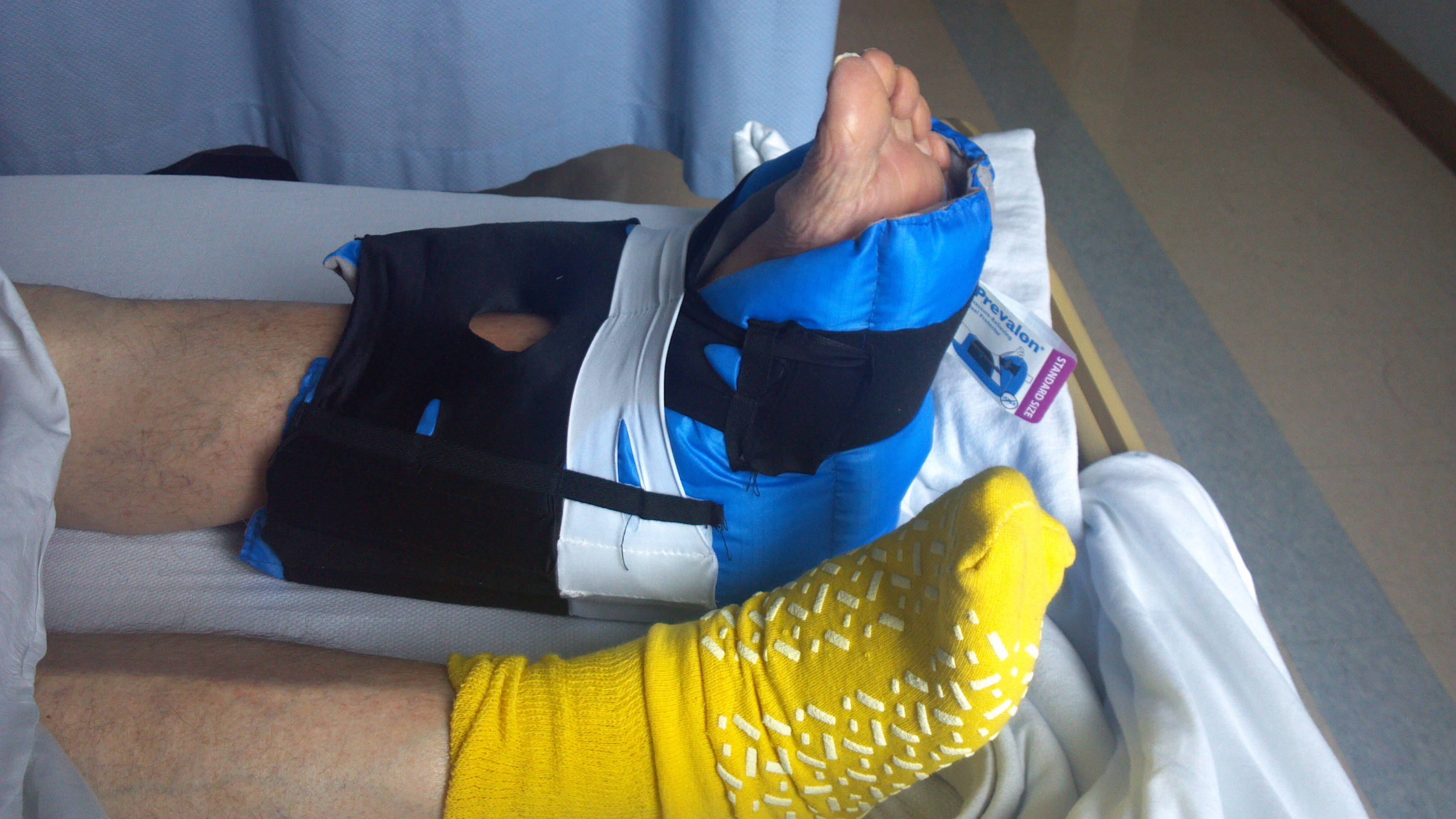
Done with the bank; going to Dad’s– a 30 minute trip from here. The books are in the back of the van. I’m not planning on bringing the wheel chair. He uses a walker now, but we may opt to dose him with a bit of hydrocodone after debriding his heel and Achilles wounds. Today marks 3 months since the tumbling incident that started this.

Waiting at the Wound Clinic for the doctor, Dad came early and is ahead of schedule. After this, he wants to shop for produce; I may shoot two birds with one stone and do some of my own errands this way! His spirits are good and he said that sometimes he forgets his walker when moving about the kitchen. I can tell how active he’s been by how many sticky spots I clean off the floor each visit. Previously, I had to attend to change his bandages each day, except when his home health care nurse would come. Now, my sisters can also schedule in time using a Google Doc we share for that purpose.

The Wound Clinic doctor and main nurse are Irish-American; Dad chose to don his kelly green St. Pat’s sweatshirt. Tick Tock…even though we came twenty minutes early for our 1:00 p.m. appointment, it is 1:05…thinking of all the other things I could be doing. Surprisingly, Dad is not cantankerous yet at the delay. Perhaps he is listening to the court update on Jesse Jackson, Jr. and wife, or the chit chat between an elderly Chinese lady and her attending son, in Chinese. The world has changed a lot since he was a boy in Brighton Park, a neighborhood in Chicago.

1:10 Dad is funny. We have a new nurse today, Elizabeth, who is not Irish. He asked about Kelly, the Irish one, and mentions that he wore his sweatshirt just for her. Kelly is at lunch and may not see him today. For the millionth time over 3 months, he is asked about if he has pain, on a scale of 1-10… He looks at me and rolls his eyes at this point.

Alright, wound doc was optimistic and cited progress. That is only in millimeters, but still positive. He pulled the perimeter scabbing, hurting Dad. Better him than me doing it. Wound dressed and ready to go grocery shopping with hopes to get him back on the golf course by the end of September, if even only on the practice putting green. I had my own first foray of the year on Monday; 9 holes and wishing for more, but the short game killed me. Practice…

2:00 We are on the road again toward the produce market.

3:10 I’m running a tune-up on Dad’s computer because he complained that it was horribly slow. While waiting, knowing he has eaten nothing but a banana, coffee, and orange juice all day, I offer to make him lunch. What does he choose? Corn! “Where’s the wound healing, body building protein in that?” I ask him. We agreed he add some Greek yogurt to that order. Sugar/carb addiction runs in my genes, but fortunately we have no diabetes.

Two of my kids and a friend send texts to me about dinner, my whereabouts, and evening plans. I’d check in with Riad, but assume he is busy now.

Decide to email my siblings about Dad’s doctor visit. We will go to every other day bandaging since his drainage is decreasing. Computer is still in tune-up mode.

3:45 Done! Need to run to buy my Halal chicken and specialty items from the Mediterranean Market close to home and get cooking. Checked in with Riad; business was good today. Whew!

Remembering the books in the back of the van and the folding chairs we packed to see Perseid meteorites a couple days ago by our relatives in the boondocks, exurbs of Chicago.

4:05 Very sleepy, I have 2 more miles till the next tollway exit.

Yay! The Book Rescue was still open to take my donation. Next, I’m going to the health food store to buy some Redmond (UT) salt and coconut oil, then to the Mediterranean Market.

Upon exiting the health food store, I saw a man I recognized as a parent from my former school. “Assalamu alaikum,”  he greeted me kindly. It’s nice to see people in my town that recognize each other. We have a rather large population of Muslims of diverse backgrounds. This man I recalled worked at McDonald’s headquarters nearby.

If you’ve been following this blog, you might ask, “What happened to California?” Well, we would still love to relocate, but the reality is that 3 kids in college and their still unstable, dependent statuses have us pigeonholed here awhile. We also have a teenager who has decent friends, and is still at an impressionable age. It is sensible to keep that support for him. Truth be known, there are many positive aspects to living near Chicago, but I do take exception to the weather, especially the long cold season that inhibits our love of doing things outdoors. For now, if we can afford to escape a few times during that long spell, I would be satisfied. However, I do hold visions of relocating in the future when parental obligations lighten.

Also, this past Ramadan, a segment of my community started a new mosque. Lacking a building for worship though, they contracted the local high school gym during the month long evening Taraweeh prayers and hired a wonderful reciter (Qari) of the Qur’an. There, I saw many former students and teachers that just made me feel wonderful to be in their company. Even a former teacher is First Violin of the DuPage Symphony Orchestra; she was so kind to offer me tickets to their October Tchaikovsy concert. I have invited my nephew, a young cellist, to join me, and I am so much looking forward to that!

At the Mediterranean Market, I saw another lady who referred me to her brother-in-law in Ohio. He was my expert consultant on an article I wrote about keeping fit in Ramadan last year. I noticed through Facebook that he has been having some health issues requiring surgeries, so we had a chance to catch up and I learned more details on his struggles.

I thought about squeezing in a bike ride as I drove home, but Riad greeted me and did not feel like biking. Quickly, I pray the last few minutes possible for Thuhr, the mid-day prayer, and also catch the starting time for Asr, the mid-afternoon prayer. Finding the best way to acquire good habits is to tag on to existing habits, I do 15 push-ups and 30 squats for exercise. We have yet to return to the gym schedule after Ramadan.

Throw the folding chairs from the van into the garage and replace 3 broken slabs of jalousie glass panes before making dinner.

5:00 Time to Cook!

Cooking time usually is when my kids know that they can get my ear when I’m in the kitchen. I really don’t love cooking, to tell the truth, but sometimes I can get into it. During Ramadan, it was not unusual to be stuck there for 5 hours at a time, but my family is spoiled to an extent. The kids generally don’t eat breakfast, but they do want a hearty dinner. That is where I put effort and often about 3 hours of my day, but I have plans for 7:00 p.m. so I have to rush.

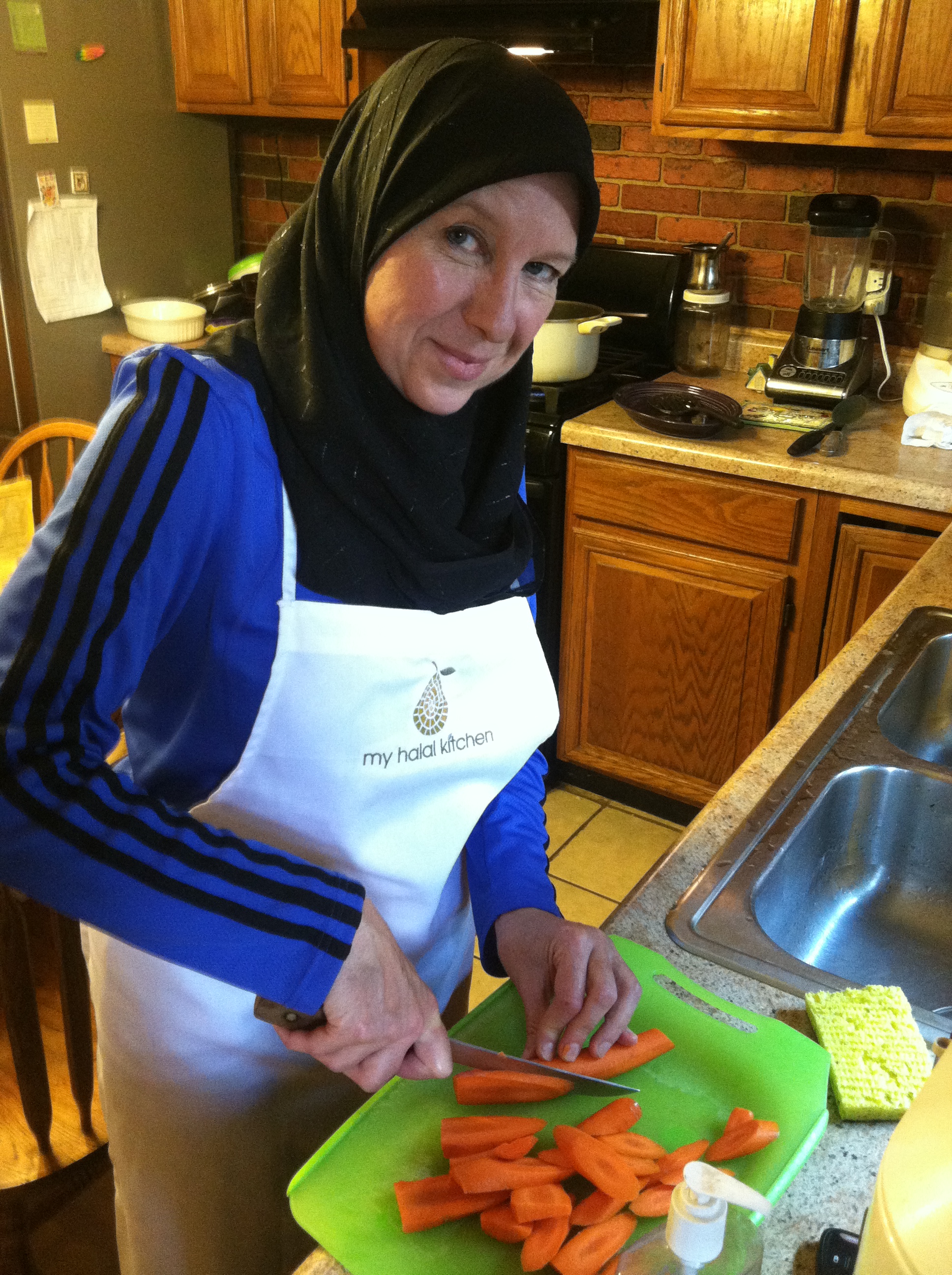
Why did the recipe state that 3-4 minutes on each side would brown chicken thighs?! It took 30 minutes! I had Moroccan Chicken Stew (magazine recipe) and a steamed kale, turkey bacon, and apple combo as a side dish. Sure enough, two of my sons take time to brief me on their day while I cook, and one acquiesced to take the picture of me cooking for a new Facebook profile pic.

Wolfing down dinner, it is 6:50 and I have to race to mid-town to see my friend, Yvonne of My Halal Kitchen, present at 7:00 at our local library. My daughter, her friend, and fiancé will attend too.

“Ramadan Food Rituals: 30 Nights of Foods That Nourish”

Presented by Yvonne Maffei, she outlined the basics of Islam, the wide array of Muslims representing many cultures and nations, aspects of the lunar month of Ramadan, understandings of Halal and Tayeb (Wholesomeness), fasting rituals in a typical day, the growth of fusion cuisine in America, Eid traditions, and my favorite…dessert demo: Stuffed Dates with Crème Fraish!

Back Home Again and Still Crankin’

9:00 Home again after Yvonne’s presentation, and I have to perform the sunset prayer. The kitchen needs post-dinner clean up, since I ran out the door with my husband still eating.

9:45 It’s time for a 4 mile walk with Riad, whereby we talk and listen to background tunes on Pandora via our phones.

11:00 Back from our walk; one of my sisters calls with news of a conference she recently attended for promotional products professionals, and we trade opinions on Dad’s care. I’m snacking on grape tomatoes and Gouda cheese. My eldest son comes home from a camping and fishing trip, and he debriefs with me by the kitchen table.

12:15 Time to pray, shower, and then my daughter visits us in the bedroom to re-cap on Yvonne’s presentation and how pictures of samosas inspired her and her fiancé to go to an Indian restaurant for late dinner. I’m really tired, but now everyone has touched base with “Mom” and one kid is still out running a nighttime neighborhood blitz type of game with friends. I decide to finally check in on Facebook, as I’d not had a chance to do so yet in the day.

12:50 My last kid is in and I’m signing off with plans to be up at 4:00 for my thyroid medicine, 5:00 for fajr, the dawn prayer, and start a new day by 8:30. Love the summer schedule!

—Next day—

There never was time to write a formal blog, per se, but time to write throughout the day. Somehow it gave me relief to purge out the extension I wished to make and document what seems like a crazed existence, but a happy one. Would you consider this a valid exercise for getting students/writers to express themselves and practice editing? 

Ramadan: Cooking, Qur’an, Collaboration

Quran Ramadan: Cooking, Qur’an, Collaboration

School’s out, but there are plenty of opportunities for learning. With Ramadan coinciding with summer break, I have plenty of thoughts toward trying out some new things. After all, life-long learning is what it is all about, and these ideas are not just for kids.

Cooking

Why not begin with expanding culinary skills? The reality of Ramadan is that we do spend a lot of time thinking about food, cooking extra special feasts, and breaking our very long fasts with family and friends. To inspire you, Yvonne Maffei of My Halal Kitchen has published Summer Ramadan Cooking. She hails from a Sicilian and Puerto Rican parentage; and she has such fondness for many cuisines that her cookbook features many traditional and fusion dishes. Yvonne is very much in demand as a blogger, is often interviewed by the media, teaches cooking classes, and is an advocate of a Halal lifestyle. She is also a talented food photographer, and you will enjoy drooling over her pictures even if you don’t lift a spoon!

Quran
In Ramadan, we don’t merely dwell on food, we also seek to improve our knowledge of the Holy Qur’an and the Arabic language. The Qur’an is recited each of the 29-30 days of Ramadan, and hearing a beautiful recitation is one of the best aspects of the month. We usually finish our sunset meal, known as iftar, and quickly clean up the kitchen to ready ourselves for the evening and night prayers, isha and taraweeh. Taraweeh involves reciting 1/30th of the Qur’an each night, and it recharges one’s spirit, commitment, and relationship to Allah. However, I can attest that the benefits of Ramadan are proportional to the efforts one applies to it, and we all could use some supportive reminders to use time well because the holy month features bonuses not received at other times.

The Prophet Mohammad said, “Whoever reads a letter from the Book of Allah will receive a hasanah (good deed) from it, and the hasanah is multiplied by ten. I do not say that Alif Lam Meem is (considered) a letter, rather, Alif is a letter, Laam is a letter, and Meem is a letter.” [At-Tirmidhi, Ad-Darimi]

In Ramadan, good deeds are multiplied by 70 or more. The Prophet said, “Whoever draws near to Allah during it (Ramadan) with a single characteristic from the characteristics of (voluntary) goodness, he is like whoever performs an obligatory act in other times. And whoever performs an obligatory act during it, he is like whoever performed seventy obligatory acts in other times.” [Sahih Ibn Khuzaymah, no. 1877]

While for non-native Arabic speakers, the task of reading the Qur’an in Arabic is a significant challenge, take heart. Aisha, who was the youngest wife and frequent transmitter of testimony about the Prophet’s daily life, quoted him, “Verily the one who recites the Qur’an beautifully, smoothly, and precisely, he will be in the company of the noble and obedient angels. And as for the one who recites with difficulty, stammering or stumbling through its verses, then he will have twice that reward.” [Al-Bukhari and Muslim] –Nice to know that I’ll get a generous recompense for my efforts!

Collaboration

Although the mainstay identifier of Ramadan is the fasting, it should be acknowledged that relationships are a priority to reflect upon and improve. Tahera Ahmad, another wonderful soul I have had the pleasure of knowing, wrote about the importance of Relationships to Ramadan, and I was very pleased when the deeper essence of Ramadan and our understanding of it came up in conversation within my home.

My daughter has a friend who recently took a break from college to complete a ten month program in Texas at Bayyinah Institute, and she gained great insights from the esteemed founder Nouman Ali Khan. The girls’ discussions and subsequent study of online resources produced by him evolved in an initial gathering of moms and their kids to open a number of topics related to being Muslim in America, wearing hijab, studying the Qur’an, nuances of the Arabic language, and we hope to continue these meetings with husbands included. We’ll see how it goes; but it occurred to me that this type of gathering, featuring multiple generations and perspectives, may also provide a venue to transmit oral histories and wisdom to be passed to our progeny. It is said that the Devil is locked away in Ramadan, and I hope topics can be discussed with mutual respect, devoid of discord.

Technology & Arts

With these unstructured days of summer, it is my hope that we can all explore some new applications of technology. Whether we are teachers, students, or just casual dabblers in nascent apps, there could be no loss in acquiring practice in something new. This video presents possibilities and features links to further resources.

On a concluding note, it has been nearly two months since my father fell in his yard, and although he has suffered and continues to convalesce at home with me and my siblings rotating constant supervision, our relationships have greatly improved and I have treasured the fortification of our family bonds.

Thoughts of death, and preparation for the eventual absence of my life, have helped the depth of my worship (ibadah) and connection to Allah. I am reminded of my responsibility to prepare myself and those around me for the inevitable journey, and I greatly appreciate the time, people, and experiences that have been gifted to me. I am optimistic that soon my father and children will be able to be more independent by the end of this summer, and I have many things I wish to pursue with a renewed sense of mission and energy. This time of reflection, course correction, salutations from distant souls, and chance to gain exponential good deeds (barakat) and warm memories with those close to me is precious.

Every dua’a that is good is answered, they say, and I have known it to be true. Ramadan Mubarak!

Rain and the Rebel

Should have had pen in hand when my ideas started to flow, as I savored a robust morning cup of coffee, Ethiopian from Trader Joe’s. Thoughts of life’s constraints and irritations tumbled about my mind, and a bit of frustration too. I had hoped to kick myself out the door for a long skipped pre-breakfast, multi-mile walk in the fresh air; but it was raining, and I decided not to walk in the rain because it would ruin my mascara and drench the clothes I intended to wear to my dad’s physical therapy session. Today, we practice transferring in and out of the car, and I am the “lifter.” This assignment fortified my commitment to lifting weights at the gym, as I’d fallen off track when my schedule changed after my father’s fall in mid-May.

Seeing the rain, the varied shades of green under pale blue-gray skies, gave me the cloak of security and peace. My property is enveloped in trees, so much so that Google Earth only shows a canopy of them from above. The grounds are carpeted with grass, shrubs of  many varieties, and of course weeds. It is a haven for beautiful birds, colorful squirrels, and even a few ground hogs and raccoons. The inconvenience of rain actually provides the other living things in my yard their life. This balance I respect, for the world does not revolve around me. However, I can appreciate it through observation.

Another school year ends today; we hope to celebrate a couple graduations this weekend with Dad able to come out of the rehabilitation facility, and already we find ourselves planning for the fall term with three kids in college, two of them still living at home. Readying for the cycle of change to come, knowing a struggle to afford it awaits, I will relish my coffee, my ability to take care for my health, fitness, and family. The pleasure of choosing what time I will engage in work activities and graduation preparation bring me some sense of liberty and autonomy, because ultimately these all come under the domain of Choice.

We choose our perception, our attitude, our actions. It is the bane that we often succumb to habits and specifically habits of mind. Therein lies the constraints we perceive. Maybe when we sense this, it is useful to shake things up and rebel from monotony by doing things differently, freely, creatively. Life, even with constraints can offer us options. We should break free and use them.

I’ll start with breakfast!

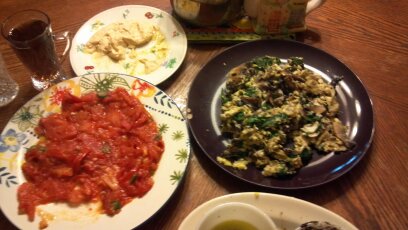
Breakfast of eggs with portabello mushrooms and spinach; tomatoes sauteed with garlic and serrano pepper, hummus, olive oil & zataar, and tea.

Breakfast of eggs with portabello mushrooms and spinach; tomatoes sauteed with garlic and serrano pepper, hummus, olive oil & zataar, and tea.


Connecting Pieces of Life-When bad things can bring something good

Back in my childhood home, I have been caring for my father as he continues to recover from a fall he had two weeks back. He needs 24 hour care since his ambulation is not stable, and he has a very painful left foot resisting expectations for a more rapid healing. Dad and I have not shared a living space for about 30 years, when my mother, father, and siblings required my assistance for a few months before her passing away from ALS. Lately, threads of memories are surfacing, not to haunt, rather to complete a personal sense of myself.2013-05-30_14-07-27_334

As God writes the best of plans, my first job when I was 16 was as a Certified Nurses’ Aide (CNA) which trained me in providing range-of-motion exercise, patient lifting mechanics, personal hygiene care, and other useful skills and knowledge. Although my work with the elderly at St. Joseph’s Home for the Elderly, run by the Little Sisters of the Poor, was just a Saturday job while I was in high school (earning $2.40 per hour), I enjoyed serving meals, assisting residents with their much awaited baths, curling their hair in the facility’s “beauty shop,” dispensing medications, and lots of listening. They used to call me “Sweet Sue.” There was Antoinette (AKA Frenchie) from Canada who used to chat with me in French. I was not fluent, but she engaged me to love the language. Someone had said that she had no visitors except one nun who also spoke her language, and so I was heart bound to her. Within a few months though, I’d learned that she was declining food, despondent to end her life. She did not acquiesce from my pleading to eat, and a couple weeks later I was crushed with grief when Frenchie had died.

Tragedy has a way of sharpening our focus and revealing character. Although only 16, I could not bring myself to continue working as a CNA; it hurt too much to know that I had no power to help “save” those in my care.

When Dad came home, all things we formerly took for granted were scrutinized, chair heights, bathroom configurations, and sleeping, medicine, and feeding schedules. A spare bed was brought down to the ground floor and an angel brother-in-law constructed risers for it as well as Dad’s recliner that made it a bit easier for him to get situated with a walker featuring wheels and tennis ball sliders.

It has been a labor of love, even getting my night owl schedule to synch with his 5 a.m. start, and although this does not feel like “home” any more—because I have my own filled with my husband and older children a 40 minute drive away—I can remember where everything is and have flashbacks of family that kind of glue the pieces of my life past to the present.

Also, as I am roughly 10 years older than the majority of my siblings, Dad’s challenges have revealed their characters as adults now. Interesting… There is a deep sense of gratitude for my husband’s understanding and support, and I have observed my children’s acceptance and willingness to also accommodate, taking on a greater share of independence and ownership of home duties. Here’s hoping that I don’t find a tornado zone upon my return!

Since my highest priority has been loving care of Dad and serving his needs the best I can, so far I found time mostly at night to do my professional work and had used the opportunity to see a rather long YouTube (1:16) presentation by Hakim Archuletta.

Wisdom is revealed throughout, identifying the nuances of ancient knowledge related to preserving health, but the last 25 minutes of the recording hits several tidbits of good measure that clue the viewer toward a vision that aligns with what intuitively matches my own. It is worth the time to explore, and I believe answers to the causes of some deep seated illness can be discovered. The concept of “connection” converged with events in my family circles, and I value what I perceive to be God’s hints to promote healing in many of them and their relationships.

Along this line of thinking I reminisced that by digitizing old video media and about 750 photos and slides I inadvertently healed rifts that formed amongst my brood, as there’s a lot of testosterone in my house, and sometimes ego clash. By seeing our kids, we realized some things that were never apparent before. One of the most comedic was to see birthday videos of our youngest at ages 2 and 3 where his older brother merely asked to cut the cake. As parents we probably just did not want to risk him using a knife or anticipated hassles, but we put him off with a solid, “No,” and really emphasized it when he balked. Ah, parent guilt! We promised ourselves that the next family party–a high school graduation–could relieve and deliver us from potential fixation if we finally let him, at 23 years, to finally cut the cake. I wonder if the video game I always saw him play, the one with guerilla combat and hunting knife, had anything to do with that!

In viewing themselves, the kids piped up, “We were such pests!” I saw exceedingly patient parenting, but the beauty of sharing the video memories is that we remembered some really great and harmonious family times, when they were still so cute and innocent. They were close, and seeing it that way again rekindled the bonds, which were perhaps taken for granted.

All in all, I now have current media, replicable technology, which can be passed down to connect us to future generations. Appreciation of togetherness, respect, just sharing meals, and taking time are immensely healing and should not be dismissed as insignificant while our society’s patterns are shredding these conventions apart.

When I was an assistant principal, my raison d’etre was to help people develop and discover their potential. In that capacity, I connected individuals in many ways: to other people, resources, and sometimes to their inner selves. This vocation permeates my self-concept of being a type of guardian angel to help, promote, develop and connect those who can benefit from knowledge, assistance, and by lending an ear. I have been granted blessings I deem worthy of sharing, and I wish to remind readers what Hakim Archuletta pleaded with followers to do. Make it a priority, make time to connect, breathe, and live.

—–Update: Dad is back in the hospital, another one. The medical system foibles have been revealed. Two hospitals, sets of doctors, home health care confusion, and a holiday weekend delay in having competent follow-up resulted in a very bad foot infection that causes immense pain. Thanks for Loyola Medical Center and their teams for bringing a quick admission, expertise, and relief. We hope to go back “home” tomorrow or the next day.

~God is the One who has created all of you originally weak. Then after your weakness, He brings about strength in you, Then after your strength, He brings about weakness in you and the gray hair of old age. He creates whatever He so wills. For He is the All-Knowing, the Almighty. Thus, the Day the Hour of Doom shall come, God will raise the dead, and the defiant unbelievers will swear that they had not remained in the world but for an hour. Even so, they were deluded about the truth of the Hereafter.

But those in life who were given revealed knowledge and who had faith will say to them: Very truly, you have remained in existence from the time of your creation until the Day of the Ultimate Rising–in accordance with the decree in the Book of God. Thus, this is the Day of  the Ultimate Rising. Yet you did not ever seek to know of it!

Then on that Day, those who did wrong by worshipping false gods shall not benefit from their justification for it. Nor shall they be allowed to propitiate the wrath of God for their ungodliness.

Now very truly, We have put forth for the good of all people in this Quran, something of every kind of illustration. Yet even if you were to bring them, O Prophet, a miraculous sign as proof from God, those who disbelieve would still, most surely say: You and the believers are nothing but progenitors of falsehood!

And so it is that God seals up the hearts of those who do not seek to know truth from fallacy.

Therefore, be patient, O Prophet. Indeed, the promise of victory from God is ever true. Thus do not let those who have no certainty in God and His judgment unsettle you. (30:54-60)

Hospital, Hope, and Historic Legacy

Hospital, Hope, and Historic Legacy

Perched on the 7th floor of a suburban hospital, I peer at the Chicago skyline in the distance. Here for five days after my father suddenly “lost power” in his legs while feeding the birds in his yard; it was 92 degrees and he was stranded, baking for a few hours before a neighbor miraculously found him. While the event was unpleasant, he feels blessed as his children have risen to the cause as his advocates with numerous staff and specialists, tests, logistics, and he instigated a chain of reunions and collaborations that give him satisfaction, and above all, the feeling of love. We anticipate discharge to a physical rehabilitation within days.
1367685774908 With all the nasty news headlines, political and economic stresses, it distills down to this—we prevail when we have Hope. In Dad’s case, all testing so far was mercifully unspectacular, and an additional benefit, as I ponder it, is that rehab guided by professionals may speed up his recovery from winter doldrums to result in out-performing me in golf! I had better get my own training on track, in spite of numerous overseas relatives who have added to the complexity of my task schedule.

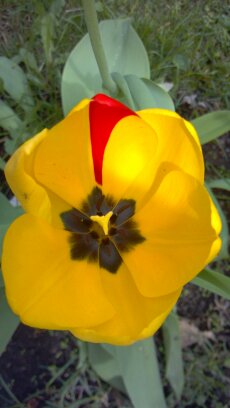
Yet, before spring sprang with its tulips, redolent lilacs and hyacinths, I was prompted to read Tariq Ramadan’s Islam and the Arab Awakening. It was not part of the Muslim Journeys book list, but I wish it was because he has a global following. This review will summarize contents and some of my own perspectives derived from his ideas.

Ramadan analyzes historic, geopolitical, and currently relevant perspectives. In his prescription for Arab and Muslim majority countries, he echoes a call I have heard even from OIC business research circles, that there is need for reform in education to foster innovation, critical thinking, and establishing a mission based stance toward collective responsibility, which may even question leadership if a better solution may be conceived. He recognizes the need in light of economic ripples from globalization, and the necessity of guidance and requirement to utilize young people in work. In particular, the value of women’s education and autonomy is acknowledged, and resolving poverty and corruption, which has undermined societies.

In timely manner, he qualifies that Islamic shariah implies a call for justice, dignity, and freedom. It supports religious, cultural, and political pluralism. Ramadan’s expertise is qualified, as he holds a PhD. in Arabic and Islamic Studies from the University of Geneva (Switzerland), and he contends that shariah is not constitutionally rigid and reductive. He also explains that the often misunderstood term of jihad “resists racism, dictatorships, corruption and oppression.” He states that “only when Muslim societies actively envision and work for nothing less than these values can they achieve liberation.” This is a far different portrayal of these terms—shariah and jihad—than what the American public has been led to believe.

Efforts of a deliberate misinformation campaign have been revealed, as I have learned of several reports in the past year. Truly Machiavellian, there are enough well plotted schemes that convince this to be reality, not a conspiracy theory. Yet, Ramadan does not address these at all. What he does note though are the inequities of powerful nations in their willingness to engage in resolutions within Egypt, Libya, and Tunisia as contrasted with Syria and Yemen. Specific interest was abetted to unrests in petromonarchies of Bahrain, Saudi Arabia, and Qatar. Meanwhile, we also see further power plays and economic polarization in Greece and Cypress, and we question when will the purge end? Who loses and who gains? How can “they” get away with it, and can the juggernaut be halted without a hard landing? The printing of fiat currency is heading toward Jupiter with futile hope of ever meeting debt obligations on every scale. It’s a house of cards, and even my overseas guests—who sport the shopping malls have reported that designer brands are selling out, while middle-America is not even in the mall or they’re just window shopping.

My eldest children have commented that nearly all their classmates from high school and college have no job, and this we see in Arab societies as well. Educated and un or under employed, we have too many PhDs. What benefit was their education for? A better effort is required for guiding students toward employable fields and majors. Ramadan writes that “critical intelligence is mandated to resolve the waste of human capital. Globalization and unemployment needs some turnkey solutions, and although not everyone is an entrepreneur, we must utilize resources in a fulfilling and sustainable manner.” Working to eliminate poverty is a solution; yet, the widening gap of haves and have nots is directly oppositional to the solution required.

Ramadan’s writing expresses hope for Muslim majority societies to take the initiative in building its own alternative order. In my mind I sense powerful potential parallels with the Dark Ages and subsequent rise of the Golden Age of Islam which eventually catalyzed into the Renaissance. However, with the internet and social media’s pan-identity of “we” there is optimism to breach entrenched nationalistic, gender, and religious divisions in exchange for a united, humanistic bond with willingness toward inclusion.

The power of the people was just a glimmer in the Arab Spring, and we wait for its awakening to cure the malaise threatening our existence. To build, Ramadan calls for the following three priorities
• The dignity of the individual and labor
• Defined conditions for fair and equitable trade
• Compassion and efforts to relieve the poor

While Arab and Muslim majority societies seek solutions, it is fair to evaluate weaknesses, in order to recognize their vulnerabilities. Since Ramadan clearly rests the responsibility to ultimately lie with the people, irrespective of corrupt leaders and plots, he diagnoses that many greatly lack Spirituality. Of course, there are deeply spiritual people scattered in every society, he qualifies that the masses are not devoid of “religion,” rather they lack its deeper infused essence. “Adherence to rituals, and even moral concern, fall short of spirituality depicted as having a rock solid base in a meaning to life and peace in one’s heart resulting from an unshakable belief that permeates one’s personality resulting in inner security and serenity.”

He calls out that rhetoric and formality have taken precedence over the spiritual core, and that some people incorporate Sufi practices while maintaining parallel to them secular lifestyles. We’ve seen this in American society where there was a rising interest in Buddhism and yoga. While not all who choose yoga as their form of exercise connect to the spiritual relation to it, the popular rise of it into mainstream was sparked by people seeking to fill a void.

Who could blame them for casting away religion when it seems that all dogmatic religions “take away” and “restrict,” rather that enrich? Moreover, the argument that religion “gives comfort” can easily be dismissed because many other less polyanna-ish pursuits can also give at least a temporary comfort.

Ramadan contends, “What lies at the heart of spirituality is the willingness to not resist against life’s challenges, because at some point exhaustion sets in, if unabated. When the human reaches its limit in its ability to suffer, the only recourse is to reach beyond one’s self to an entity who never fatigues, who creates all, and can deliver ultimate relief. Certainty of this entity’s existence and a personal connection to it defines one as a Believer. The depth of the relationship between Creator and Believer determines the degree of spirituality. Just as muscle improves with effort, spirituality is deepened with effort to connect with one’s Creator. In our often busy lives, this requires an investment of time and consciousness. That justifies why Muslims pray 5 times a day, to maintain that “hand hold” and bond.”

Far from simply hiding and praying, a spiritual person is called upon to actualize virtue in caring for themselves, their fellow humans, plants, creatures, and the environment. The manifold aspects of this can be applied to all realms of life. For me, Ramadan’s clarification reminds that aspects of this should resonate throughout education, social, political, economic, cultural and artistic work. For every type of occupation, I can easily perceive its relevance in serving for a greater good, whether it be through social work, fine arts, math and science, literature and communication, law, health care and fitness, politics, agriculture, animal husbandry, travel, logistics, trade, manufacturing, marketing, finance, and defense. All are acceptable if they serve toward building and preserving a legacy of dignity for all, and respecting the benevolence and wisdom of the Creator. This respect and acceptance of the Creator’s higher authority is what feeds spirituality. Behaving contrary to one’s inherent autonomy, status of trust, honor, and responsibility erodes it.

My vocation in Education—inclusive of the plurality of languages, customs, arts, cuisines, and other facets of culture—can help us discover our own pan-identity. Giving meaning and worth to other cultures gives respect and bonds humans as global partners.

——-Enough heavy analysis; levity also bonds humans. To that extent, I’ve a hankering for reading something by P.G. Wodehouse. After all, balance is a characteristic of Islam, and much time hanging out at the hospital with Dad has me chomping at the bit to get moving outdoors as soon as I can assure he is comfortable in an interim setting to get his legs and lungs ready for golf.

“Bee” an Advocate for Earth

541871_10152735073770564_466614551_n When travails of life wear us down, I have taught my children to seek solace in nature’s wonders. Last weekend, for example, I’d really needed a “fix” and went to a local park district owned farm to commune with the sheep. A particular sheep really “connected” with me and followed me around the property, probably to get more petting. Somehow, after that encounter, I felt better, at peace, and happier. The long drawn out winter had taken a toll, and this gave me resilience.

Similarly, my kids have acknowledged that they find the same comfort from being outdoors, and they reminisce about camping trips we tried to take each year. Alhamdullilah, I feel that I gave them a valuable resource and coping mechanism in appreciating the creation and grounding comfort it provides; for where we live, we really don’t get to feel comfortable outdoors from November until April, and this April still features “April showers” that have kept us bound indoors…except for the recent foray to the farm. Too much of a good thing, we have a bit of flooding in our basement that I will attend to after writing this piece about resources you can use for class in acknowledgement of Earth Day, this Monday, April 22nd.

Earth Day Ideas

Introduce students toward stewardship of the Earth and citizenship with the power of petitions. There is one for support of organic farmers at http://tinyurl.com/d6l8sbo. Students need to be at least 13 years of age.

Edutopia.org, one of my favorites, has a blogger, Matt Davis, who posted “Earth Day 2013: Lesson Plans, Reading Lists, and Classroom Ideas” http://tinyurl.com/d4kqbt8. This has many resources for lesson plans, unit plans, games. Also, there are handouts, activity sheets, online games (really fun!), and contest links. Note that the EcoKids Canada link within Matt’s piece has resources for First Nation and the Inuit as well. From here you can get ideas for activities, projects, and scavenger hunts.

What About the Common Core State Standards for ELA non-fiction?

My latest interest, as prompted by speaking to a 40 year veteran of beekeeping at the farm, is learning about bees. One third of commercial beehives have been decimated in the past year, and the impact is dramatic on several levels. The crisis has been labeled Colony Collapse Disorder (CCD), and it might qualify as an intriguing topic integrated across several academic disciplines for the Common Core State Standards (CCSS) that increase the quantity of non-fiction reading expected of students.

Peruse WKSU’s Vivian Goodman’s “Why You Should Care if Honey Bees Can’t Find Their Way Home,” www.wksu.org/news/story/35148. The site has a 7 minute podcast as well that gives a bit of history about legendary bee expert A.I. Root and serves as a hook to the article.

There are many amazing things about bees. Their antennae are smell detectors, and are up to 100 times more sensitive to odors of flowers, nectar, and propolis than humans’ odor detection abilities. Pollution dilutes bees’ sense of smell, for which the antennae operate independently, similar to our ears. They navigate by the sun, and communicate the location of nectar plants by “dancing” to direct members of their hive. What is spectacular I found is that their precision in direction is in single degrees of orientation and that they also home in using the same. Commercial beekeepers that travel all over the country know to relocate the hives only after sundown so that bees can reorient their location somewhere new each day. How they know exactly where to find their hives, the inner workings, efficiency of labor, and processes are miracles. I have learned these things from my current read, which is A World Without Bees by Allison Benjamin and Brian McCallum.

Much of the book gives insight to research conducted about CCD and potential reasons for 800,000 colonies being lost in 2007, and 1 million in 2008. This crisis has affected bees in Canada, Europe, Asia, and South America. Theories include implications from disease, fungus, pesticide toxicity, viruses, and electro-magnetic disruption. France and Italy reported associating a nicotine-based pesticide, imidacloprid, manufactured by Bayer CropScience, with CCD, and it is now partially banned in France. Neonicotinoids are sometimes called “neonics” and are neurotoxins that have been implicated in affecting the bees’ sense of navigation and immunity, according to an article in Mother Jones by Tom Philpott, “3 New Studies Link Bee Decline to Bayer Pesticide,” http://tinyurl.com/cdjqwlk .

With high stakes on both sides, Big Agriculture vs. Bees there is a petition also against the use of these pesticides at http://tinyurl.com/bbekaqj .

Films that may be of interest are:
“Silence of the Bees” http://www.pbs.org/wnet/nature/episodes/silence-of-the-bees/introduction/38/
“More Than Honey” http://ecowatch.com/2013/dwindling-bee-populations/
See bonus material from “More Than Honey”—enjoy the German! http://youtu.be/00u30q0XqUw

In Closing

Now, as the “great outdoors” doles rain/snow/showers/wind at 40 degrees, I’m ready to slog through the mess in my basement so that I can not feel guilt when Spring–whenever it comes–gives us 60 and I get back to the farm on my bike to visit “my” sheep.

Halal United with the IFANCA International Halal Food Conference

485393_508092375914024_1569907556_n

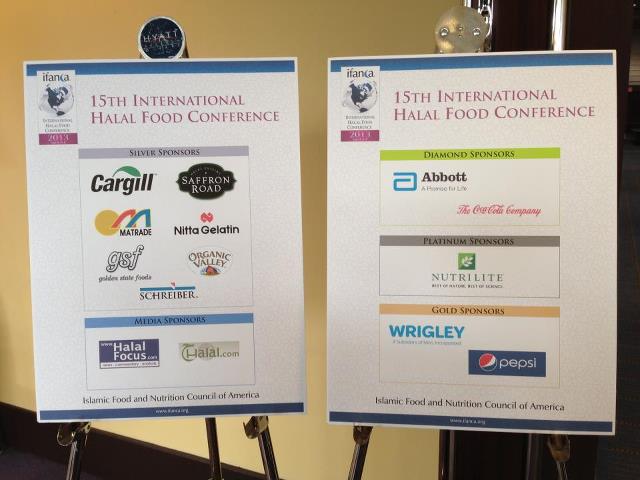
Food bridges diverse cultures effectively, and it forged bonding at the International Halal Food Conference, hosted by the Islamic Food and Nutrition Council of America (IFANCA) April 6-8 at the Hyatt Regency Hotel in Rosemont, Illinois. The event brought a multinational array of corporations; among them were Abbott Nutrition; The Coca-Cola Company; Amway-Nutrilite division; Wrigley-subsidiary of Mars; PepsiCo; Cargill; American Halal Company; Organic Valley; McDonald’s Corporation, and others  lesser known to the public but that have products used by other companies in their formulations.

Several dignitaries from the governments of Indonesia, Malaysia, Singapore, and food scientists, export agency representatives, entrepreneurs, and consultants, from the U.S., Canada, U.K., Belgium, Switzerland, Kuwait, U.A. E., Pakistan and India rounded out the program.

The theme of Unity was iterated by several presenters who acknowledged that the former stance of protectionism and competition needs to be cast away in exchange for transparency, mutual support and cooperation. Attending the IFANCA conference were other Halal certifying agencies, and ISNA’s Ahmed El-Hattab called for a unification of Standards and formation of an ISNA Accreditation Board.

IFANCA’s founder and president, Dr. M. Munir Chaudry, stated the objectives of the gathering included import/export requirements; introducing Halal entrepreneurship opportunities; presentations on animal welfare; and advice of food safety and security. Naming brands of their certified products, Cabot Cheese; Baskin Robbins; and Tom’s of Maine, he expressed that although there are 8 million Muslims in the U.S. and 1 million in Canada they are not visible, even though they represent $18 billion in purchasing power.

Adnan Durrani, Chief Halal Officer of American Halal Company, and spokesperson for the hugely successful Saffron Road presented a video with grocery industry magnate Errol Schweizer, senior global grocery coordinator for Whole Foods Market, who sees “Saffron Road is the fastest growing brand in the frozen category.”

The National Association for the Specialty Food Trade, Inc. (NASFT) president, Ann Daw, noted in the video that “Halal should be a mainstream concept.” Durrani explained that “70% of our [Saffron Road] customers are not even Muslim.” He has consistently presented Halal as an aspect of Ethical Consumerism, and further explains “It’s about how we conduct our business…how we conduct ourselves in the world.”

Of the $8-9 billion in Kosher food sales, nearly $3.5 is bought by Muslims, and in Whole Foods supermarkets the Saffron Road line is first in frozen entrée sales. Within the larger sphere of grocery stores, the brand is 6th as it enjoys 250% growth. Success has been achieved through synchronized social media with print, online, retail merchandising, and extending to the blogger community.

In the realm of Halal foods, 35% of sales are processed foods and 10% in meats, according to Mian Riaz, PhD., director of food and protein at Texas A&M University. He stated that this is not a niche market anymore, and that 1.5 billion people eat ritually butchered food each day.

Abdalhamid Evans, founder and senior analyst of Imarat Consultants, further defined the scope of the Halal industries as finding shared values beyond religion. “They see Halal as lawful, safe, nutritious, healthy, humane, demonstrating awareness, and equitable,” Evans declared. “These values have commercial worth, and are described as eco-ethical and moral.”

Evans, a global Halal expert knows, “Halal has different connotations in different parts of the world. There are very nuanced contexts that corporations need to be aware of. Certification as a ‘cottage industry’ is going to end. Halal is big business and on the verge of becoming irrevocably sophisticated and complex. Certification is going through changes. Industry is looking for clear standards so there is a checks and balance. They want to see an accreditation industry with transparency.”

A new development is the application of the term to the Finance industry. Evans explained, “What Islamic Finance needs to do is get more involved in the real economy.” His message was that investment and financing should not be sought for gain, but more for building the strength, education, and solid economic stability for all. Halal then becomes an asset class with indexed funds, venture capital, and micro finance.

Emphasizing the need for unity, Hani Al-Mazeedi, Kuwait Institute of Scientific Research, expert in Halal quality, safety, and services, cited that the initial standards will be guidelines. Mark Overland, director of global certification at Cargill, Inc.— IFANCA’s Company of the Year—mentioned that his company has about 200 Halal certified plants out of their 800, based on consumer demand. None are in the U.S. His view is “We should recognize what consumers want, and then deliver that with integrity,” and he has echoed the sentiment for unity by advocating a council.

Underscoring many speakers was the impression that business people, researchers, and religious scholars often have no concept of the realities of each other’s constraints. The current challenge is to establish trusting relationships, communication with good will, and efforts to find equitable solutions.

Susan Labadi is project coordinator of the American Halal Association, president of Genius School, Inc.~A Professional Development Company, consultant for the ISNA Education Forum, and VP of ActionNet Trade, Inc.

Muslim Journeys Bookshelf

muslim-home-left-art The Bridging Cultures Bookshelf: Muslim Journeys Grant, through the National Endowment for the Humanities, in cooperation with the American Library Association and the Ali Vural Ak Center at George Mason University, has enriched 950 recipients among libraries and state humanities councils.

The winning institutions receive a collection of books covering themes: American Stories, Connected Histories, Literary Reflections, Pathways of Faith, and Points of View. Although I would have wished a few other authors included, I am very pleased to see Ingrid Mattson’s The Story of the Qur’an: Its History and Place in Muslim Life, G. Willow Wilson’s The Butterfly Mosque:  A Young American Woman’s Journey to Love and Islam, and Eboo Patel’s Acts of Faith, the last of which was a required reading assignment for incoming students to Elmhurst College.

In addition, there are 3 DVDs: Prince Among Slaves (2007), Islamic Art: Mirror of the Invisible World (2011), and Koran by Heart (2011). I’ve coaxed my library to rush the processing of the art film, as it is a new acquisition, and have it reserved for me to be the first patron, hopefully to share it with others.

One of the benefits with an expiration date is access to the Oxford Islamic Studies Online Database for a year. This is only for those who have a library account via their local institution for log-in. See the following link to reference if your library is included:  www.programminglibrarian.org/muslimjourneys/mj-bookshelf/mj-selected-libraries.html

Finally, Islamic Art Spots is a DVD of seven video essays which provide an introduction to Islamic art and architecture related to the project themes. The entire Muslim Journeys collection contents can be viewed at http://www.programminglibrarian.org/muslimjourneys/mj-bookshelf/mj-collection.html

___________________________________

Nearing the end of the dreaded month of March, with its tenuous grip on winter, I’m relieved to be on the homestretch. Two weeks ago, I managed to injure my back while merely brushing my teeth before dawn. Determined to heal quickly, I’d alternated walking 5 mile days with days of rest, and I was glad to make it out and walk/run today about 3 miles with out incident. However, it was not pleasant to be dashing between snow flurries that morphed into tortuous slapping of my face with pins of sleet. Spring indeed! Meanwhile, my niece and nephew in Phoenix are cavorting in their pool with expectations of summer.

The ISNA Education Forum is near and the rest of this week will be devoted to preparations while I monitor my children who are all on Spring (hmph!) Break. I’m looking forward to next week already when I can split my brain only between Halal brainstorming meetings and our export business strategic planning.

Halal Fests Making a Wave in America!

Halal Food Tour Realizing the potential of Halal foodies at their community’s Halal Food Festival, co-founders of the popular web show Sameer’s Eats, Sameer S. Sarmast and Saad Malik, were blown away when the anticipated 1000 attendees swelled to a wave of 4000! Last August’s festival was planned with the local New Jersey Muslim Youth Community Center (www.myccnj.org), and Malik reported that most vendors even ran out of food. Mesmerized by the diverse crowd, Malik turned to his partner and said, “Dude, this is mind boggling. We need to take this on the road.”

Stoked by inspiration, Sarmast confirmed, “We saw that great Halal food brings people together no matter their race, religion, or professional background. This year we’ve decided to spread Halal food across America. We’re putting on five big events in five cities. We look forward to working with local organizations in each city to help their initiatives and more.”

The Halal Food Tour (www.halalfoodtour.com) has them partnered with Yvonne Maffei, the personable and effervescent publisher, cookbook author, and blogger of My Halal Kitchen (www.myhalalkitchen.com). The five city tour will kick off with Los Angeles on April 13th; then to New York in June, Washington DC in August, Chicago in October, and finally to Houston in December.

Besides appearances by Maffei, several other celebrities have signed on to appear at some of the venues. Mo Sabri, singer and lyricist; Preacher Moss, the thought provoking writer and founder of “Allah Made Me Funny” Muslim Comedy Tour; Aman Ali, reporter, storyteller, and co-creator of “30 Mosques in 30 Days;” and Omar Regan, who is best known for his acting and comedy talent. This creative production team is seeking many more popular Muslim personalities and businesses in each city that represent the diverse American Muslim landscape. The ticketed events are expected to bring much publicity to the nascent Halal Movement in America.

safe_image

Also inspired by the huge attendance of the New Jersey festival, Irfan Rydhan, the Event Director of Jam-Productions is collaborating in partnership with Atif Qureshi of Zabihah.com ( the world’s largest guide to Halal Restaurants and Products) and Javed Ali, founder of ILLUME Media (www.illumemagazine.com) to produce “California’s First Halal Food & Eid Festival” aka “Halal Fest” (www.HalalFest.com) for August 17th in the main parking lot of NewPark Mall in Newark, CA.

The event is open to the public and is scheduled approximately 1 week after Eid ul-Fitr. Rydhan stated that their intent is to cultivate awareness of delicious Halal food, promote Muslim businesses, and express diversity and cultures in an atmosphere of fun for the whole family with children’s air jumpers, super slide, and merry-go-round. Halal Fest will feature Halal food trucks, restaurant booths, and a large bazaar with approximately 30 vendors selling a variety of clothing, jewelry, arts & crafts, books, and other novelties.

Nationally recognized Chef Jimmy Sujanto of Padi Restaurant in Berkeley, CA that features Indonesian Halal dishes, will be there to conduct a Live Cooking Demonstration. Representing a variety of cuisines, arrangements have been made for Indo-Pakistani , Middle Eastern, African-American Soul Food, and Indian-American Fusion as well as the standard food festival fare of burgers, fried chicken and pizza – all Halal of course. Surely, it should entice everyone to explore some new flavors and bridge cultural gaps to familiarize neighboring communities with Halal food from Northern California.

For the adventurous set, the multi-talented partners have signed on a live skateboarding demonstration by professional American Muslim skateboarder Jordan Richter (read his story here: http://www.illumemagazine.com/zine/articleDetail.php?Wayward-Son-The-Jordan-Richter-Story-13769), and other activities for the whole family to enjoy are in the works.

Will this be the year for Americans to really catch the wave? Don’t miss it; sign up if you are a Halal enterprise or vendor. These events are likely to be the start of something big for Americans who really love food, and who doesn’t appreciate great Halal, healthful delights that appeal?